
Recently, CCA California signed on to a letter addressed to California Natural Resources Agency Secretary Wade Crowfoot. These comments were submitted on the Pathways to 30×30 draft document prepared in response to the Governor’s Executive Order N-82-20, committing California to conserving 30% of our lands and coastal waters by 2030 (30×30). You can find that letter below!
Via electronic delivery
February 15, 2022
Wade Crowfoot
Secretary
California Natural Resources Agency 715 P Street, 20th Floor
Sacramento, CA 95814
Dear Secretary Crowfoot;
Thank you for the opportunity to provide comments on the Pathways to 30×30 draft document prepared in response to the Governor’s Executive Order N-82-20, committing California to conserving 30% of our lands and coastal waters by 2030 (30×30). The undersigned, representing hundreds of thousands of sportsmen and women in California, express our optimism for the Administration’s interest in advancing measurable conservation objectives, designed to increase access to and promote interest in all forms of outdoor recreation, including hunting and angling. In this letter we are pleased to provide the following feedback and a list of areas that we believe provide enduring conservation of California’s coastal waters.
First, we encourage the Administration and the California Natural Resources Agency (CNRA) and others implementing 30×30 in California to collaborate closely with members of the commercial fishing and sporting-conservation community. Many member-based NGOs regularly utilize their available funding and membership base for voluntary efforts to enact remarkable science driven conservation programs and projects across the country. Many of these programs are collaborative efforts with state or federal agencies, which again aligns closely with the Administration’s call for collaboration, while others have actually served as the template by which many existing programs are modeled. Such efforts highlight the effectiveness of collaborative, stakeholder driven conservation while recognizing the importance of engaging with the sportsmen’s community in the development of future conservation programs and projects.
Increasing importance given the growing calls for equitable opportunities for all Americans to enjoy our nation’s public trust resources, state fish and wildlife agencies are charged with providing public access opportunities for wildlife-dependent outdoor recreation. In addition to their management of state-owned lands and waters maintained for an array of access, state agencies should develop additional opportunities to provide public access to all managed lands and waters. This includes access for traditional outdoor heritage activities, including consumptive take through hunting and fishing. In fact, the State’s own efforts through the R3 program are designed to do just that…get more Californians involved in hunting and fishing across our great state.
Recreational and commercial fishers embrace meaningful protections for biodiversity. Our avocation and vocation depend on healthy abundant ecosystems. We do not shy away from measures designed to conserve biodiversity. Threats to biodiversity can and should be specifically identified so that remedial measures can be taken. Similarly, marine activities that do not pose an identifiable, genuine threat to biodiversity should not be constrained. Otherwise, the executive order’s command to increase outdoor and natural resources access to all California citizens would be turned on its head.
Our particular goal here is to avoid needless restrictions on existing sustainable fishery activities. This is where we part ways with some stakeholders. We do not believe that additional fishery restrictions are justified except to the extent that the constrained activities meaningfully cause an articulable biodiversity threat. We also recognize that nearly every problem associated with coastal water challenges (pollution, ocean acidification, warming, sea level rise, etc.) is completely independent of recreational or commercial fishing activity. We could support measures to address those potential harms to habitat to conserve biodiversity. However, these challenges must be separated from fisheries impacts, and accounted for as such. Where our activities have shown a demonstrated harmful impact to marine resources, our communities have willingly and meaningfully engaged to provide remedies (whale entanglements, drift gill nets, bottom trawling, etc.).
Our March 10, 2021 letter to Secretary Crowfoot and CNRA set forth our goals in the development and implementation of 30×30 policy proposals that include:
- Recognition of the positive role that fishing plays in conservation;
- Protected area definitions that allow for well-managed and sustainable fishing;
- Consideration of existing protected areas in measuring progress toward stated goals;
- Targeted, science-based conservation measures developed through a stakeholder-driven
process to address biodiversity threats;
- Waters currently available for fishing should remain open and available unless reduced
access is proven necessary to prevent the loss of coastal biodiversity;
- Clearly defined roles and authorities for the entities charged with carrying out the 30×30 initiative proposal.
The recreational angling community and commercial fishing industry supports these policy proposals and reiterates that both fishing sectors are integral to providing access to the living marine resources in California’s coastal waters. Whether it is private recreational fishing vessels or commercial passenger carrying fishing vessels that provide direct access to those resources, or the seafood harvested for Californians by the commercial fleet – we play an integral role in ensuring access.
Unfortunately, we do not see many of these principles clearly articulated in the draft Pathways document. If allusions to them are there, we would suggest that they need to be more explicitly identified and highlighted.
What Constitutes Conservation for the Purpose of Achieving 30×30
The most fundamental question to be answered here is: What is conservation? Different stakeholders bring different perspectives, but some veer toward a different but related concept. We think that the federal report Conserving and Restoring America the Beautiful well illustrates the distinction between “conservation” in Gov. Newsom’s executive order and how the term is misused in the Draft Pathways report and by some stakeholders.
The President’s challenge specifically emphasizes the notion of “conservation” of the nation’s natural resources (rather than the related but different concept of “protection” or “preservation”) recognizing that many uses of our lands and waters, including of working lands, can be consistent with the long-term health and sustainability of natural systems.
Carefully defining the term “conservation” is key to measuring success while ensuring broad stakeholder support. Here, our use of the term reflects the “wise use” definition coined by Gifford Pinchot in the early 20th Century. It is this definition, and varieties thereof, that has been championed by the sporting-conservation community for more than a century. Currently, the Cambridge Dictionary defines conservation as “carefully using valuable natural substances thatexist in limited amounts in order to make certain that they will be available for as long a time as possible” while the U.S. Fish and Wildlife Service defines the term as “controlled use and systematic protection of natural resources (fish, wildlife, and their habitats).”
Unfortunately, conservation has been redefined by some to conflate with “preservation.” For example, Webster’s updated definition reads, “a careful preservation and protection of something.” Not only is this redefinition misleading in its conflation between the concepts of conservation and preservation, but, outside of the context of natural resource management, it is often illogical (e.g., energy conservation).
The conservation of biodiversity means measures resulting in the long-term health and sustainability of natural systems. It should not matter that the measures were implemented to benefit one set of species provided the benefits flow generally to species coexisting in the same habitat. This is the case in designated essential fish habitats, where the benthic habitat receives a high level of protection for certain targeted species. However, all species in that habitat receive the same benefit.
This historically used definition of conservation should not be interpreted as functionally different than the definition in the Draft Pathways document that calls for “coastal water areas … managed to support functional ecosystems, both intact and restored, and the species that rely on them.” Nonetheless, the Draft Pathways document fails to acknowledge the many different measures in place to support functional ecosystems, instead applying a narrower, more restrictive definition.
What is Already Durably Conserved?
When considering ocean protections, attention often turns toward area-based designations under various forms of marine protected areas (MPAs). However, what should also be considered are the science-based biodiversity conservation measures already in place through the regulatory process established by the Magnuson-Stevens Fishery Conservation and Management Act and the eight regional fishery management councils (the Pacific Fisheries Management Council here in California) as well as those established by the Marine Life Management Act and the Fish and Game Commission.
There are numerous examples of management measures that achieve improved conservation outcomes that benefit the health of fisheries as well as other marine species and habitats. It can be argued these science-based measures that identify and address specific concerns have already effectively exceeded the 30×30 biodiversity conservation goals in our marine waters while still allowing for sustainable uses and public access. The regional councils under the Magnuson- Stevens Act should serve as the lead for determining what is already conserved, as well as additional areas or networks of areas where their fisheries management efforts would support long-term conservation goals.
First, as we have argued from the outset based on the myriad of state and federal laws and regulations specifically designed to conserve marine resources, California may have already achieved its objective of conserving 30% of the state’s coastal waters (from the shoreline to three miles offshore). To assume otherwise is to decide the result ahead of a deliberative, fact-based process.
Second, despite hosting a series of workshops on regional and topical themes related to 30×30, CNRA provided no meaningful collaborative opportunity for stakeholders to engage and discuss the two foundational principles that must and will guide 30×30 implementation in California, namely: the definition of conservation of biodiversity, and how much of the state’s coastal waters are already deemed conserved for purposes of the Executive Order.
In previous conversations, CNRA staff has articulated the viewpoint that the Governor does not believe California has met the goals of 30% conservation, otherwise he would have not issued this Executive Order. We have reviewed the Executive Order. While Governor Newsom was explicit about the goals, the executive order does not conclude that existing biodiversity conservation in California’s coastal waters is inadequate. To the contrary, Governor Newsom ordered that an “inventory” be undertaken of current biodiversity actions.
CNRA was also ordered to “establish the California Biodiversity Collaborative (Collaborative) to bring together” a wide range of stakeholders. That Collaborative was to be consulted on the inventory and many other issues in preparation for a report due February 1, 2022. We have seen no evidence that CNRA established the Collaborative let alone included stakeholders from our community. Nonetheless, CNRA concluded that “coastal waters that currently meet California’s 30×30 definition of conserved account for … 16% of total coastal water area.” Specifically excluded were waters of the National Marine Sanctuaries, which are considered to conserve biodiversity by the federal 30×30 effort. Rejected or ignored were a host of other measures undertaken to conserve species. The actual process for reaching 16% in the draft document was not public or collaborative.
We appreciate that conservation measures should be durable. What we are challenged with is the draft Pathways document’s definition of durability. Durability does not equate to permanence, as there is no such thing in law or policy. Conservation measures are promulgated either through statute or regulations. In either case, the measure endures until the legislative or regulatory authority chooses otherwise. This is true at all levels of government; there is no principled distinction in durability between the federal and state processes.
In conversations with some stakeholders, we have been told that federal regulations issued by the National Oceanic and Atmospheric Administration (NOAA) are not relevant because they are influenced by the Pacific Fishery Management Council (PFMC). Therefore, such regulations are allegedly not “enduring.” To the contrary, NOAA regulations are just as enduring as any regulation promulgated by California’s Fish and Game Commission. Whether state or federal, the regulation stands unless and until it is changed. If federal regulations are not enduring, then no regulation is enduring and this discussion is moot.
Further, Congress, through the Magnuson-Stevens Act, called for “a national program for the conservation and management … to facilitate long-term protection of essential fish habitats.” “The term ‘conservation and management’ refers to all of the rules, regulations, conditions, methods, and other measures which are designed to assure that … irreversible or long-term adverse effects on fishery resources and the marine environment are avoided.”
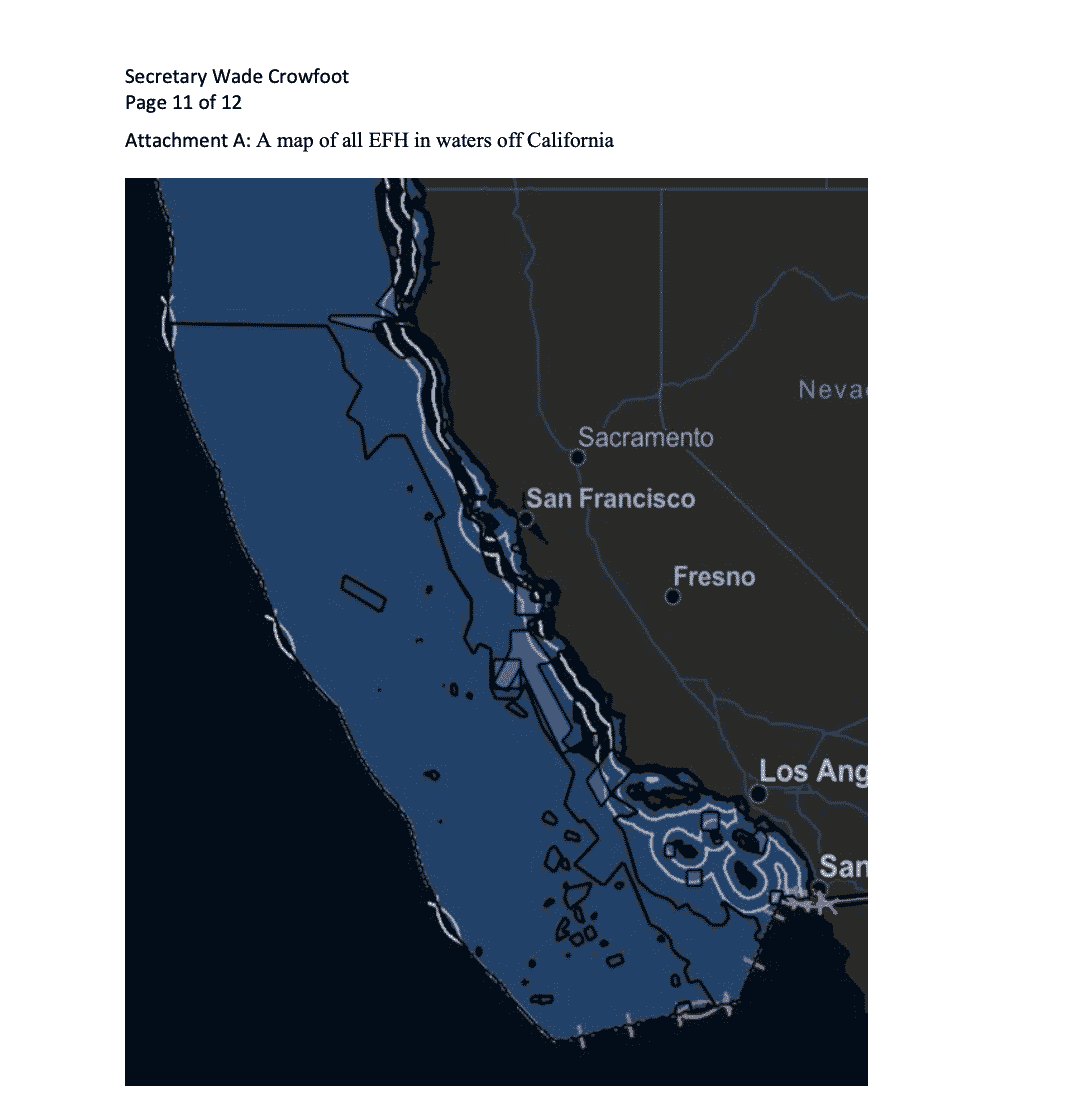
Section 303(a)(7) of the Magnuson-Stevens Fishery Conservation and Management Act requires NOAA’s National Marine Fisheries Service (NMFS) to take steps to minimize to the extent practicable adverse effects of fishing on essential fish habitat (EFH). NMFS works with the Pacific Fishery Management Council to protect EFH in support of healthy ecosystems and sustainable fisheries in the U.S. Pacific Ocean. A map of all EFH in waters off California is attached to this comment letter (Attachment A). https://www.habitat.noaa.gov/application/efhinventory/docs/pfmc_datasheet.pdf
Measures undertaken under the Magnuson-Stevens Act to protect essential fish habitat are intended to be long-term and thus “enduring.” Are those measures permanent? No more nor less permanent than California’s designation of marine protected areas. While essential fish habitat designations do not necessarily inhibit non-fishery threats to biodiversity, the designations prohibit fishery activities that would adversely affect such habitat, thereby conserving the habitat and the biodiversity therein. Additional measures directed to non-fishery impacts may be necessary to classify these areas as conserving biodiversity. But adverse fishery impacts are already addressed.
Position on Advisory Committee
While we all were promised a seat at the table in discussions on 30×30, we acknowledge that our role will not likely be that of an advisor on the committee. It is unfortunate that our very real concerns and our knowledge gathered over many years on the water and participating in fisheries management has been relegated to mere stakeholder status. That we were afforded only two public opportunities for direct dialogue with the Agency is disappointing. We remain hopeful that as the process moves forward, we will be viewed as valued contributors.
Revision to Draft Pathways Document
Our most significant concern with the Draft Pathways document is its conclusion that “coastal waters that currently meet California’s 30×30 definition of conserved account for … 16% of total coastal water area.” That conclusion is not supported by the Collaborative process specified by Gov. Newsom. If the CNRA intends to embark on a collaborative process to inventory coastal waters covered by existing measures that function to conserve biodiversity, then it should say so in the Pathways document and withdraw the 16% claim in its entirety.
The Pathways document should instead state that an examination will be undertaken to determine which existing areas are “managed to support functional ecosystems … and the species that rely on them.” Set forth in this document are examples of defined coastal waters established and managed to support intact and restored functional ecosystems. Aside from the areas listed in the table below, we ask that the CNRA take note of the following:
- In 1990, California voters passed Proposition 132 which banned the use of gill nets and trammel nets in coastal waters off central and southern California. Since its passage in 1990, the statutes implementing Prop 132 have been further amended to increase the conservation benefit. See Fish and Game Code §§8680 et seq.
- Fish and Game Code §§8494 et seq legislates halibut trawl grounds available to vessels permitted to prosecute that fishery. Section 8495 lists those areas which have been designated halibut trawl grounds. The vast majority of the State’s coastal waters are off limits to that gear type.
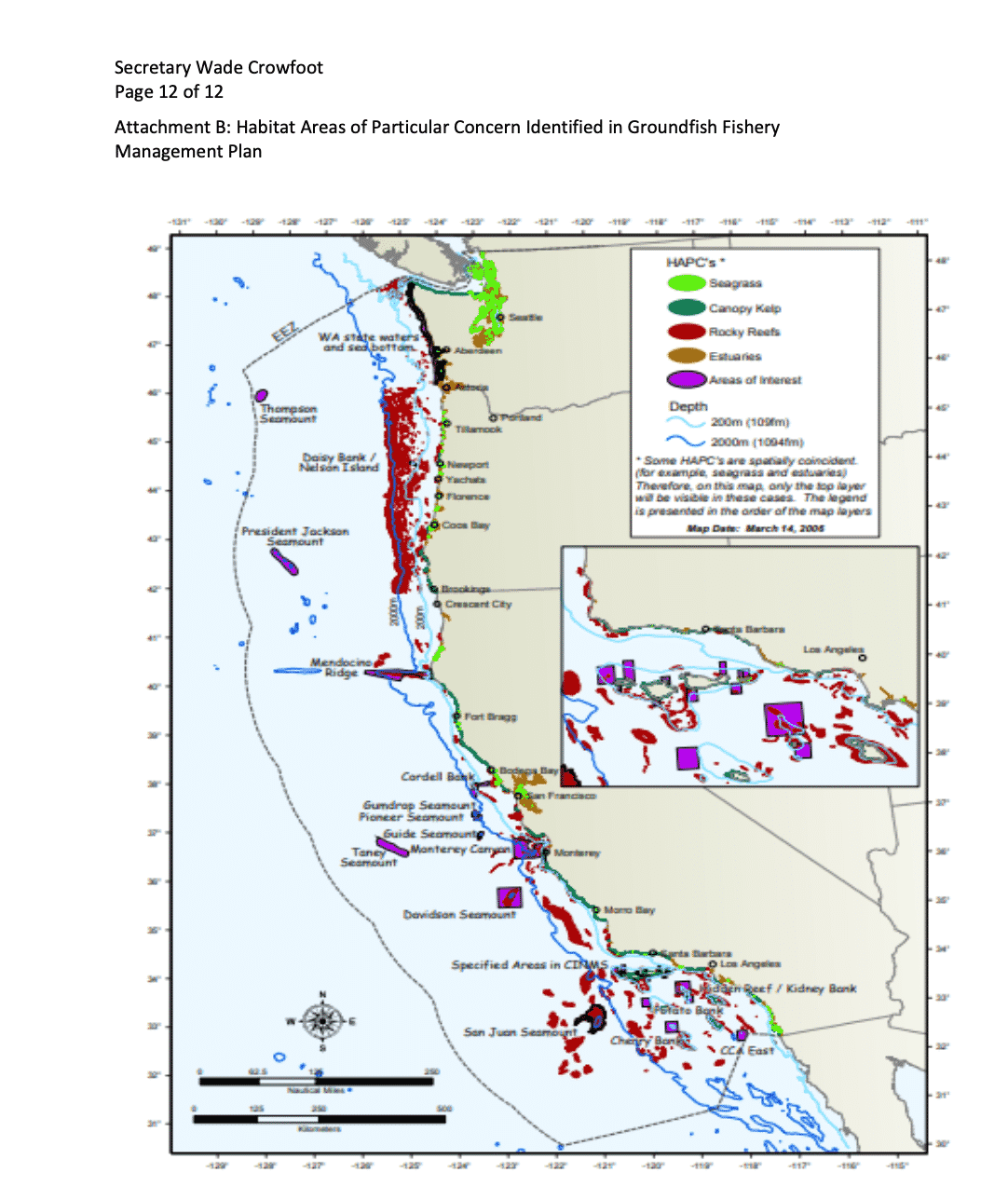
- Under federal law, Habitat Areas of Particular Concern (HAPCs) are “defined as subsets of EFH that exhibit one or more of the following traits: rare, stressed by development, provide important ecological functions for federally managed species, or are especially vulnerable to anthropogenic (or human impact) degradation. They can cover a specific location (a bank or ledge, spawning location) or cover habitat that is found at many locations (e.g., coral, nearshore nursery areas, or pupping grounds).”
- HAPCs are defined in federal regulations after formal rulemaking. They focus increased scrutiny, study, or mitigation planning compared to surrounding areas because they represent high priority areas for conservation, management, or research and are necessary for healthy ecosystems and sustainable fisheries.” https://www.fisheries.noaa.gov/west- coast/habitat-conservation/habitat-areas-particular-concern-west-coast
- A map of Habitat Areas of Particular Concern is included with this document (Attachment B).
Inventory of Areas That Conserve Biodiversity
Below are well-defined areas that have durable regulatory constraints that serve to conserve biodiversity. 


|
Name Channel Islands National Marine Sanctuary |
Size 1,470 sq. miles |
Comments Recognized as MPA conserving biodiversity by federal 30×30 effort, allows fishing outside of 11 reserves; no bottom trawling in state waters |
|
Cordell Bank National Marine Sanctuary |
1,286 sq. miles |
Recognized as MPA conserving biodiversity by federal 30×30 effort, allows fishing for pelagics |
|
Monterey Bay National Marine Sanctuary |
6,094 sq. miles |
Recognized as MPA conserving biodiversity by federal 30×30 effort, allows fishing; minimal bottom trawling in state waters |
|
Greater Farallones Marine Sanctuary |
3,295 sq. miles |
Recognized as MPA conserving biodiversity by federal 30×30 effort, allows fishing; no bottom trawling in state waters |
|
Chumash Heritage National Marine Sanctuary (proposed) |
7,670 sq. miles |
Would be recognized as MPA conserving biodiversity by federal 30×30 effort, allows fishing; no bottom trawling in state waters |
|
San Pablo Bay National Wildlife Refuge |
13,190 acres |
Protects migratory birds, wetland habitat, and endangered species. The refuge and San Pablo Bay supports the largest wintering population of canvasbacks on the west coast, and protects the endangered salt marsh harvest mouse and the California clapper rail. Fishing is permitted. |
|
Don Edwards San Francisco Bay National Wildlife Refuge |
30,000 acres |
Preserves and protects wildlife habitat; protects migratory birds and threatened and endangered species; and provides opportunities for wildlife-oriented recreation and nature study for the surrounding urban communities. |
|
San Francisco Bay National Estuarine Research Reserve |
3,700 acres |
One of the most urbanized estuaries in the world, the research, stewardship, education, and coastal training that goes on here works to promote long-term viability and resiliency of such an important estuary ecosystem. |
|
California Coastal National Monument |
Provides unique coastal habitat for marine- dependent wildlife and vegetation on 6 mainland units and more than 20,000 rocks, islands, exposed reefs, and pinnacles along the California coastline. Additionally, the monument includes public lands and serves as “nesting habitat for an estimated 200,000breeding seabirds and thousands of loafing and breeding marine mammals, including harbor seals, and California and Steller’s sea lions.” |
|
Mendocino Ridge EFH Conservation Area |
302,198,400 acres |
EFHs use scientific data to protect, conserve, and enhance living marine resources. EFHs targeting spawning, breeding, and feeding grounds for a wide variety of species, thus protecting biodiversity. Harmful fishing practices prohibited. |
|
Blunts Reef EFH Conservation Area |
12,896,000 acres |
EFHs use scientific data to protect, conserve, and enhance living marine resources. EFHs targeting spawning, breeding, and feeding grounds for a wide variety of species, thus protecting biodiversity. Harmful fishing practices prohibited. |
|
Delgada Canyon EFH Conservation Area |
3,157,120 acres |
EFHs use scientific data to protect, conserve, and enhance living marine resources. EFHs targeting spawning, breeding, and feeding grounds for a wide variety of species, thus protecting biodiversity. Harmful fishing practices prohibited. |
|
Tolo Bank EFH Conservation Area |
8,739,200 acres |
EFHs use scientific data to protect, conserve, and enhance living marine resources. EFHs targeting spawning, breeding, and feeding grounds for a wide variety of species, thus protecting biodiversity. Harmful fishing practices prohibited. |
|
Monterey Bay/Canyon EFH Conservation Area |
342,446,720 acres |
EFHs use scientific data to protect, conserve, and enhance living marine resources. EFHs targeting spawning, breeding, and feeding grounds for a wide variety of species, thus protecting biodiversity. Harmful fishing practices prohibited. |
Respectfully submitted (in alphabetical order),
Bill Shedd
Chairman
American Fishing and Tackle Company
Mike Leonard
Vice President of Government Affairs American Sportfishing Association
Secretary Wade Crowfoot Page 9 of 12
David Kennedy
Boat US Government Affairs
Boat Owners Association of The United States
Andrea Lueker
President
California Association of Harbor Masters and Port Captains
Peter Zaleski
President
California Yacht Brokers Association
Jeff Angers
President
Center for Sportfishing Policy
Wayne Kotow
Executive Director
Coastal Conservation Association of California
Mark Gorelnik President
Coastside Fishing Club
Keely Hopkins
Pacific States Assistant Manager Congressional Sportsmen’s Foundation
Kate Pearson
President
Marine Recreation Association
Chris Mitton
Manager, Public Policy
National Marine Manufacturer’s Association
James Stone
President and Executive Director
NorCal Guides and Sportsmen’s Association
Mike Conroy
Executive Director
Pacific Coast Federation of Fishermen’s Associations
Jerry Desmond
Director of Government Relations Recreational Boaters of California
Secretary Wade Crowfoot Page 10 of 12
Ken Franke
President
Sportfishing Association of California
cc: Jennifer Norris, Deputy Director California Natural Resources Agency Director Chuck Bonham, California Department of Fish and Wildlife Dr. Craig Shuman, California Department of Fish and Wildlife
Dr. Mark Gold, Ocean Protection Council
Jenn Eckerle, California Natural Resources Agency